
Front vs Rear Service LED Displays: A Buyer’s Guide
Article Summary
Compare front- and rear-service LED displays by access space, installation type, maintenance workflow, cost, and site constraints before approving a quote.
Front-service and rear-service LED displays can look almost identical when they are running. The difference becomes important when a module, power supply, receiving card, or cable needs attention. If the service method does not match the site, a clean-looking installation can become difficult and expensive to maintain.
For buyers, the decision is not simply about choosing the newer design. It is about access space, wall structure, screen size, weather protection, technician safety, and how quickly the display must return to service. This guide explains how to compare the two approaches before approving an LED display quotation.
What Is a Front-Service LED Display?
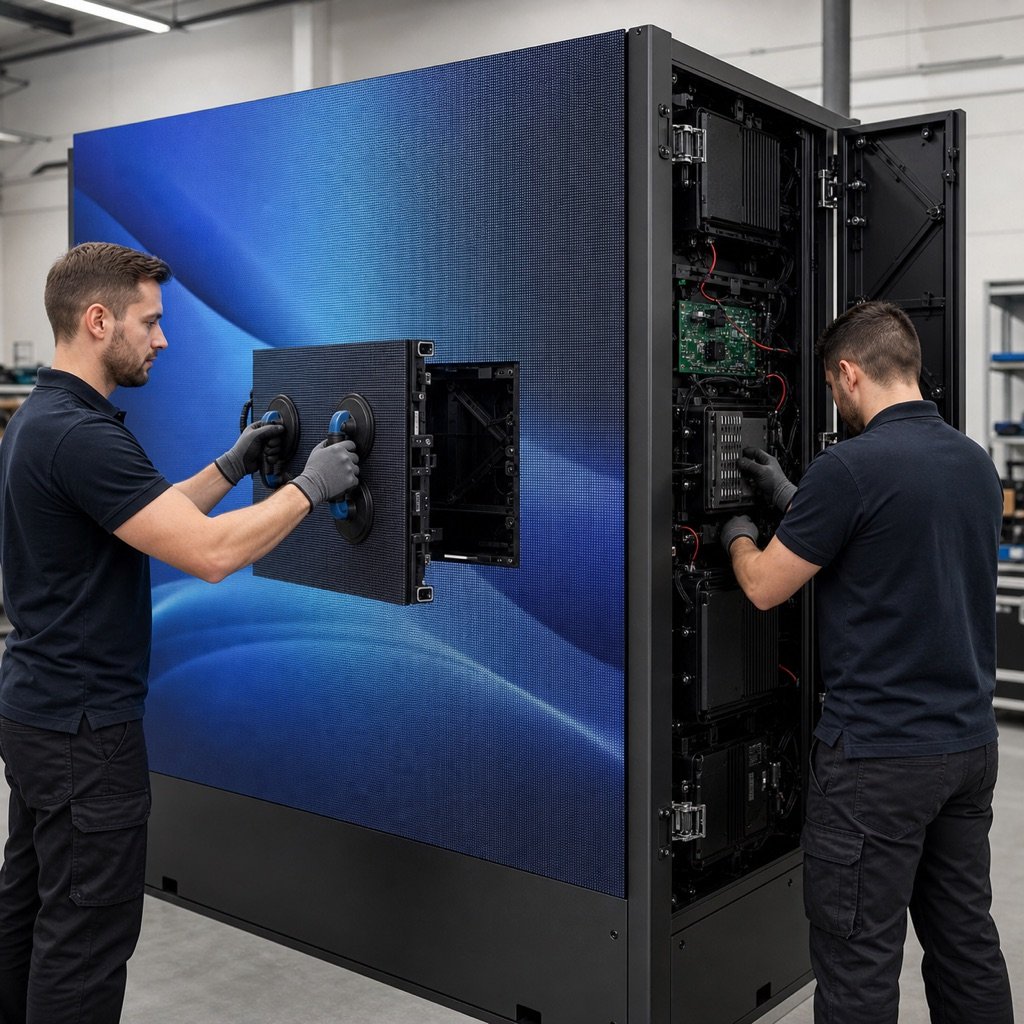
A front-service LED display allows technicians to remove serviceable parts from the viewing side. Depending on the cabinet design, that may include LED modules, power supplies, receiving cards, and internal cables. Magnetic modules and a vacuum or suction tool are common, although the exact method varies by product.
The main advantage is that the screen can sit close to a wall or inside a shallow structure. This is useful for retail walls, meeting rooms, control rooms, lobbies, and other locations where there is no practical service corridor behind the display.
What Is a Rear-Service LED Display?
A rear-service LED display is maintained from behind the screen. Technicians normally open cabinet doors or access the rear frame to reach modules, power supplies, receiving cards, and wiring. The screen therefore needs enough space behind it for a person to work safely and remove parts.
Rear service remains practical for many outdoor billboards, freestanding structures, building façades, and large fixed installations. When the structure already includes a secure service platform or walkway, rear access can make component inspection straightforward.
Front Service vs Rear Service: Quick Comparison
| Decision Factor | Front Service | Rear Service |
|---|---|---|
| Space behind the screen | Little or no technician access required | Service corridor, platform, or rear access required |
| Typical installations | Wall-mounted indoor screens, retail, meeting rooms, shallow structures | Billboards, freestanding screens, façades, large fixed structures |
| Maintenance position | Technician works from the viewing side | Technician works behind the display |
| Cabinet and structure | Often supports a thinner overall installation | May use simpler cabinet access when rear space already exists |
| Main risk to check | Tool clearance and secure removal of front modules | Adequate, safe, weather-protected rear working space |
These are general patterns rather than fixed rules. Some cabinets offer both front and rear access, while others provide front access only for modules but rear access for power and control components. Ask exactly which parts can be replaced from each side.
Choose Front Service When Rear Space Is Limited
Front service is usually the stronger option when the LED wall must sit flush against a solid wall or when every centimeter of room depth matters. An indoor LED display in a boardroom, broadcast room, shopping mall, or reception area often falls into this group.
It can also simplify the supporting structure because a full rear corridor may not be needed. However, do not evaluate cabinet depth alone. Confirm how the technician reaches the top and center of a large screen, where removed modules can be placed, and whether the front tool can be used without damaging nearby finishes.
Choose Rear Service When the Structure Already Provides Access
Rear service can be a sensible choice when the project already includes a dedicated maintenance platform, enclosed service space, or accessible steel structure. Large outdoor LED displays often use this arrangement because technicians can inspect connections and replace internal components without working in front of traffic or the viewing area.
The rear space must be designed as part of the project, not left as an afterthought. Check working width, entry route, ventilation, lighting, drainage, cable management, and how cabinet doors open. Outdoor projects also need an enclosure and access plan suited to the local weather and structure.
Five Questions That Matter More Than the Label
1. Which Components Are Actually Front-Serviceable?
“Front service” may refer only to LED modules. Ask whether power supplies, receiving cards, hub boards, and signal cables can also be reached and replaced from the front.
2. What Is the Real Installed Depth?
Compare the complete depth of the module, cabinet, frame, cabling, ventilation space, and wall finish. A thin cabinet does not guarantee a thin installation if connectors or airflow require extra clearance.
3. How Will Technicians Reach Every Cabinet?
A service method is only useful if staff can reach the failed part. Consider screen height, lifts or platforms, nearby furniture, public opening hours, and whether maintenance would interrupt the venue.
4. Can a Module Be Removed and Reinstalled Without Damage?
Ask for a maintenance demonstration. Watch how the module is released, supported, disconnected, aligned, and recalibrated. The correct tool and a controlled workflow matter more than a marketing claim about fast service.
5. What Spares and Training Are Included?
Confirm the spare modules, power supplies, receiving cards, tools, labels, diagrams, and training included in the proposal. Our LED display supplier evaluation guide lists additional questions for comparing support and documentation.
Maintenance Access Checklist for Your RFQ
- Installation drawing with screen width, height, and total available depth
- Photos or video of the wall, structure, and access route
- Required front, rear, or dual-service method
- List of components replaceable from each side
- Minimum maintenance clearance recommended by the cabinet supplier
- Module removal tool and safe handling procedure
- Access plan for the highest and center cabinets
- Ventilation, cable, drainage, and door-opening clearances
- Recommended spare-parts package and component labeling
- Maintenance demonstration or training before handover
Add these details to the dimensions, viewing distance, environment, content, and electrical information in our LED display project planning checklist. A supplier can then compare complete installation options instead of quoting a cabinet in isolation.
Common Buying Mistakes
- Assuming front service is always better: It adds little value when a safe rear corridor already exists and the structure is designed around it.
- Leaving access decisions to the installer: Cabinet type, steelwork, ventilation, and access should be coordinated before production.
- Comparing cabinet price only: Include structural depth, platform work, wall finishing, tools, labor access, and future downtime.
- Accepting a vague “full front maintenance” claim: Request a component-by-component access list and a video demonstration.
- Forgetting module alignment: Ask how replaced modules are adjusted so they sit flat and match the surrounding image.
Which Service Method Should You Choose?
Choose front service when the screen must sit close to a wall, the room cannot spare a rear corridor, or maintenance needs to happen from the public side. Choose rear service when the structure already provides secure access and technicians can work behind the screen without creating new space or safety problems.
For some projects, dual access offers useful flexibility. The right answer depends on the complete installation, not the product name. Ask the supplier to mark every serviceable component and required clearance on the technical drawing before you approve the order.
Planning an LED display project? Contact the Shangxian team with the screen size, site photos, available installation depth, access route, indoor or outdoor location, and preferred maintenance side. We can help compare practical cabinet and structure options for your site.
Frequently Asked Questions
Is a front-service LED display more expensive?
It can have a higher cabinet or module cost, but the complete project may require less rear space and simpler wall integration. Compare total structure, installation, access, and maintenance costs rather than the screen price alone.
Can an outdoor LED display use front maintenance?
Yes. Front-service outdoor products exist, but the complete cabinet, sealing, drainage, structure, and maintenance procedure must suit the installation environment. Confirm exactly how modules and internal components are protected and accessed.
Can one LED display support both front and rear service?
Some cabinet systems support dual access. Verify which components are accessible from each side, which tools are required, and whether the quoted configuration includes the necessary hardware.
How This Guide Was Prepared
This guide was prepared by the Shangxian Display Editorial Team using available product specifications, factory inspection workflows, recurring buyer questions, and practical project-selection requirements.
Final product specifications, certifications, warranty terms, spare-parts quantities, lead times, and installation requirements should be confirmed for the selected model in the project quotation.